

Appearance
Results & Remediation
Results capture the outcome of test execution over time. Remediation is how you turn failures into concrete improvements in Controls, systems, and Evidence.
What this is
Testing is only valuable if it produces action:
- Results tell you what happened.
- Remediation tells you what to do next.
Where in Modulos
Project → Runtime Inspection → select a test → Resultsto see the run history and detailsProject → Runtime Inspection → select a testto run the test manually and manage links to ControlsUser → Notificationsto see alerts generated from failed or error outcomes
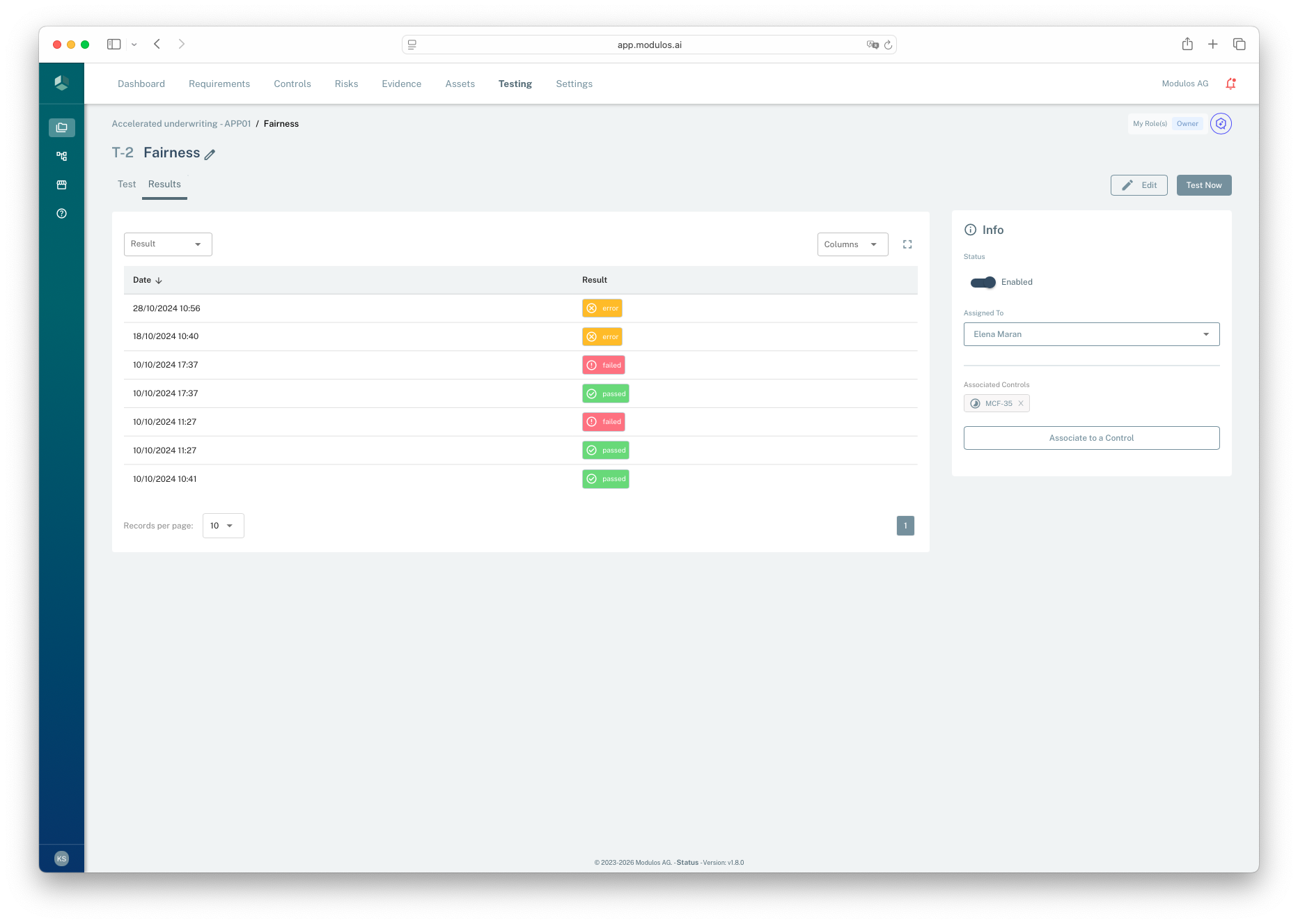
- 1Results tabReview historical outcomes for the test.
- 2Test NowRun the test manually to confirm a change or investigate drift.
- 3Result historyEach run is recorded with passed, failed, or error status.
- 4Assignee and statusRoute follow-up to an owner and enable or disable the test.
- 5Linked ControlsAssociate tests to Controls so outcomes become audit-relevant.
Result statuses
Each test run produces a result status:
- Passed: the condition was met
- Failed: the condition was not met
- Error: the test could not be evaluated because the data path was not healthy
Typical causes of error include:
- the Source connection is failing
- the metric name is missing or not found in the Source
- no recent datapoint exists in the lookback window
Who gets notified
Failed and error results are routed to the right owners:
- the test assignee
- users associated with linked Controls
Passed results are recorded for traceability but do not generally require attention.
What remediation looks like in practice
Modulos does not treat remediation as a separate silo. A practical loop looks like this:
- Triage
- If the status is error, fix the integration or the metric first.
- If the status is failed, treat it as drift in the system or Control implementation.
- Fix the root cause
- change the system, process, or configuration that the metric reflects
- Update governance artifacts
- update the Control narrative if needed
- attach Evidence that proves what changed and when
- Re-verify
- run the test manually, or monitor scheduled runs until the signal stabilizes
If a test is linked to a Control, use failures as a prompt to revisit whether the Control should still be considered executed and effective.
Related pages
Tests & Schedules
How tests are defined, scheduled, and linked to Controls
Evidence
How to attach Evidence and keep it reviewable and auditable
Reviews, Statuses, and Readiness
How execution and review workflows work across governance objects
Operating Model
The end-to-end Runtime Inspection model in Modulos