

Appearance
Roles and responsibilities
The EU AI Act assigns obligations based on your legal role in the AI value chain. These roles answer "who is accountable for what" under the Act.
Modulos also has internal roles (Owner, Editor, Reviewer, Auditor) that answer "who can do what in the platform." These are different concepts and should not be conflated.
Legal roles and obligations
| Role | Definition | Key obligations (high‑risk) | Article |
|---|---|---|---|
| Provider | Develops or places an AI system on the market under own name/trademark | Ensure compliance with requirements (Art. 8–15); maintain technical documentation; implement QMS; undergo conformity assessment; affix CE marking; register in EU database; keep logs; take corrective actions; cooperate with authorities | Art. 16 |
| Deployer | Uses an AI system under own authority (not personal use) | Use system per instructions; assign human oversight to competent persons; ensure input data quality; monitor operation; keep logs ≥6 months; report serious incidents; conduct FRIA (if public sector) | Art. 26 |
| Importer | Places a third‑country provider's system on EU market | Verify conformity assessment completed; verify CE marking + declaration of conformity; ensure authorized representative appointed; indicate own contact details on product; keep documentation 10 years | Art. 23 |
| Distributor | Makes system available on market (not provider/importer) | Verify CE marking + declaration before making available; ensure storage/transport doesn't affect compliance; withdraw/recall non‑conforming systems; cooperate with authorities | Art. 24 |
| Authorized representative | Appointed by third‑country provider to act in EU | Verify and keep compliance documentation; keep technical documentation + logs 10 years; cooperate with authorities; handle registration; terminate mandate if provider non‑compliant | Art. 22 |
Role transformation (Art. 25)
Any distributor, importer, deployer, or other third party shall be considered a provider if they: (a) put their name or trademark on a high‑risk AI system already on the market; (b) make a substantial modification; or (c) modify the intended purpose so the system becomes high‑risk.
Provider vs deployer: the key distinction
Most teams need to understand the provider/deployer split:
| Aspect | Provider | Deployer |
|---|---|---|
| Core accountability | System meets requirements before market placement | System used correctly after deployment |
| Conformity assessment | Must complete before placing on market | Not required (relies on provider's assessment) |
| Technical documentation | Must create and maintain | Must have access to instructions for use |
| Human oversight | Must design oversight capabilities into system | Must implement oversight in operations |
| Incident reporting | Must report serious incidents to authorities | Must report serious incidents to provider and authorities |
| Record retention | 10 years | 6 months minimum for logs |
How to think about accountability
A useful framing:
- Legal role defines which obligations you must meet under the AI Act
- Internal org model defines which teams own the work (Product, Engineering, Risk, Compliance, Legal)
- Platform workflow defines how you execute and audit the work
Many organizations act as both provider and deployer — building AI systems for internal use. In this case, you must meet obligations for both roles.
Mapping to Modulos workflows
In Modulos, teams implement legal responsibilities through project workflows:
| Legal obligation | Modulos location |
|---|---|
| Track requirements and fulfillment | Project → Requirements |
| Execute and review controls | Project → Controls |
| Manage evidence artifacts | Project → Evidence |
| Store scope and classification | Project → Settings |
| Assign accountability | Project → Settings → User Access |
| Generate audit packages | Project → Exports |
EU AI Act controls by role
When you add the EU AI Act framework to a project, Modulos creates controls mapped to your legal role. Here's how they align:
Provider controls
| Obligation | Example controls in Modulos |
|---|---|
| Risk management (Art. 9) | Risk identification and analysis; Risk mitigation measures; Residual risk documentation |
| Data governance (Art. 10) | Training data documentation; Bias examination; Data quality assessment |
| Technical documentation (Art. 11) | System description; Design specifications; Development methodology |
| Human oversight (Art. 14) | Oversight capability design; Operator interface specification; Intervention mechanisms |
| Accuracy and robustness (Art. 15) | Performance testing; Robustness validation; Cybersecurity measures |
| Conformity assessment | Internal control checklist; Declaration of conformity preparation |
| Post‑market monitoring (Art. 72) | Monitoring plan; Incident identification criteria; Corrective action procedures |
Deployer controls
| Obligation | Example controls in Modulos |
|---|---|
| Instructions compliance (Art. 26) | Deployment within intended purpose; Configuration per provider specs |
| Human oversight (Art. 26) | Oversight personnel assignment; Competency verification; Escalation procedures |
| Input data (Art. 26) | Input data quality checks; Data relevance verification |
| Monitoring (Art. 26) | Operational monitoring; Anomaly detection; Performance tracking |
| Record‑keeping (Art. 26) | Log retention (≥6 months); Access controls |
| Incident reporting (Art. 26) | Serious incident identification; Reporting to provider; Authority notification |
| FRIA (Art. 27) | Fundamental rights impact assessment (public sector deployers) |
Finding your controls
In Modulos, go to Project → Controls and filter by the EU AI Act framework. Controls are tagged by article reference so you can see which obligation each control addresses.
Scoping with the EU AI Act Questionnaire
The EU AI Act Questionnaire in Project → Requirements helps you determine which requirements and controls apply based on your role, risk classification, and use case. Complete it early to scope your compliance work correctly.
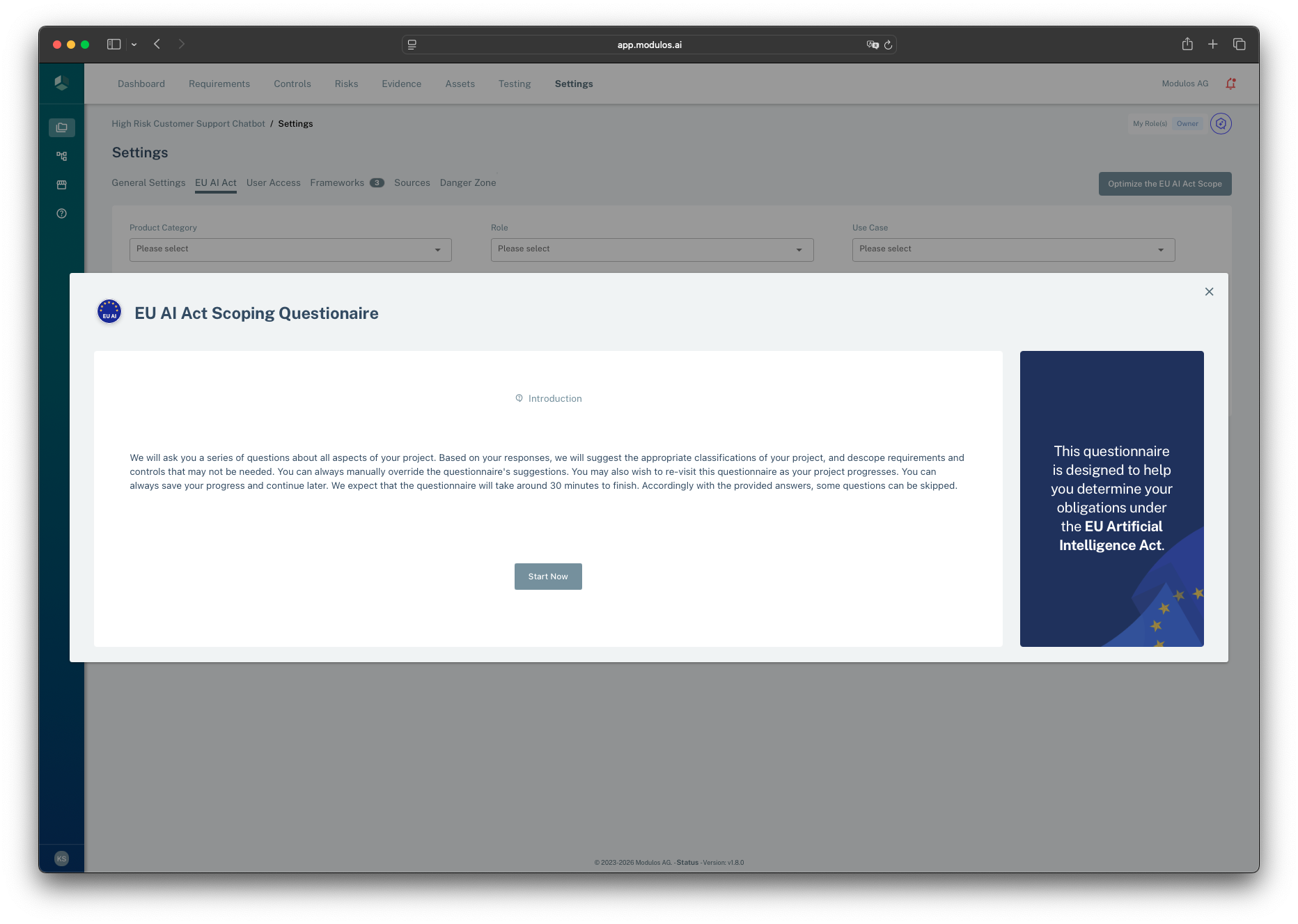
- 1Role selectionChoose whether you act as provider, deployer, or both.
- 2Classification questionsAnswer questions about your system to determine risk classification.
- 3Scoped requirementsBased on your answers, only relevant requirements and controls are activated.
Accidental provider status
It's easy to become a provider without intending to. If you fine‑tune a model, modify prompts significantly, change the deployment context, or rebrand a vendor's system — you may have made a substantial modification under Art. 25. This triggers full provider obligations including conformity assessment. When in doubt, document why your changes do not constitute substantial modification.
Separation of duties
Modulos project roles support separation of duties:
- Owners and Editors execute controls and attach evidence
- Reviewers approve controls without edit access
- Auditors view and export without modification rights
This maps to typical compliance workflows where those who implement controls should not be the same people who approve them.
For platform role assignment, see Project Settings and Organization user management.
Related pages
EU AI Act overview
Scope, classification, timeline, and how Modulos operationalizes compliance
High‑risk AI systems
What high‑risk means and what it usually requires
Conformity assessment
The two assessment routes and what each requires
Disclaimer
This page is for general informational purposes and does not constitute legal advice.